
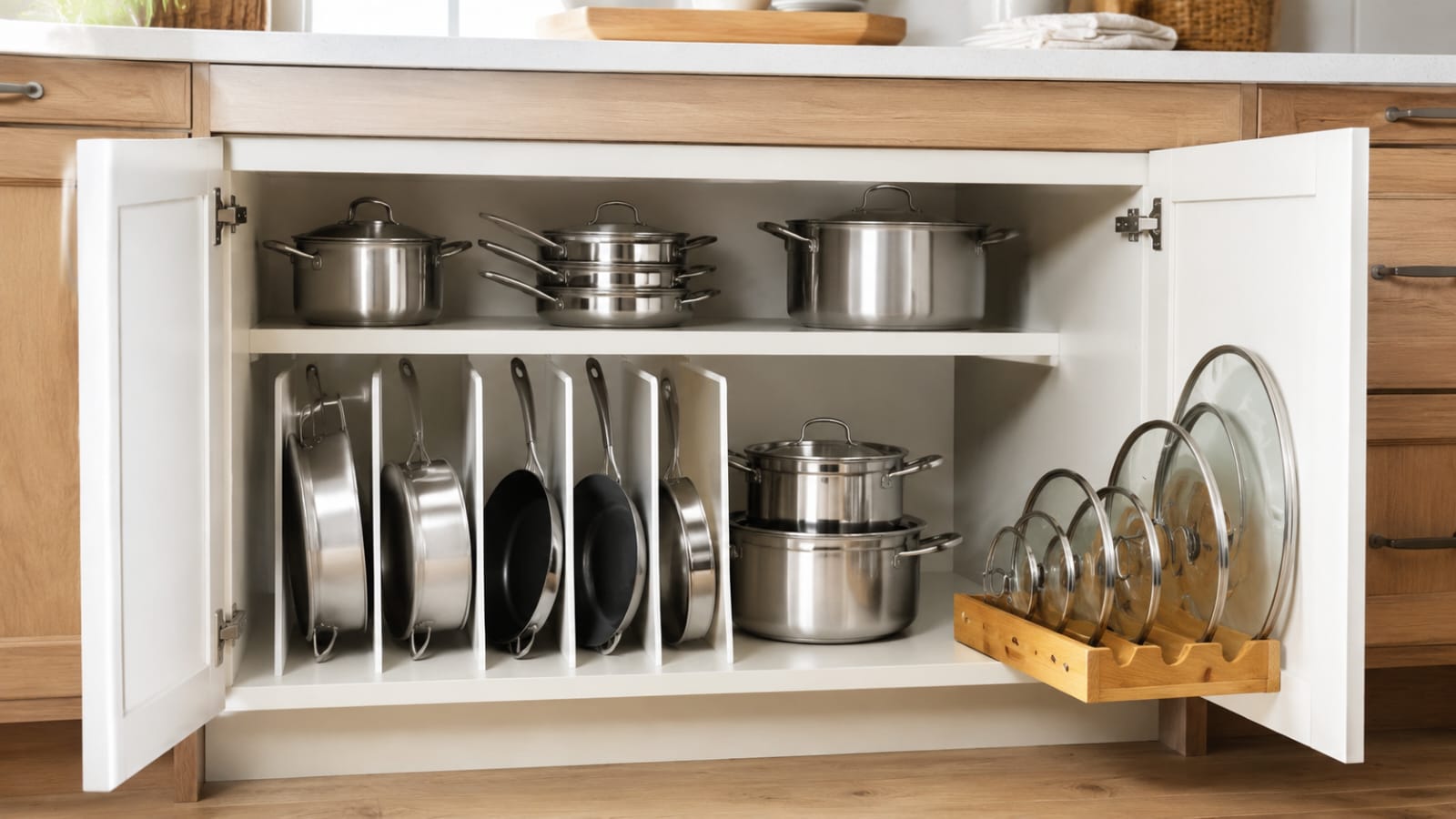
If you’ve ever opened a cabinet and had a lid come sliding out, you already know why pots and pans are hard to store. That’s exactly what these pot and pan storage ideas are here to fix. Most kitchens simply weren’t built with a good system for bulky, unevenly stacked cookware.
This list covers everything from simple cabinet fixes to full wall-mounted racks. You’ll find something that fits your kitchen, whether it’s a tiny galley layout or a spacious one, and it will end the daily cabinet wrestling match.
By the end, you’ll have a clear plan for how to store pots and pans in a way that fits how you actually cook.
Why Pots and Pans Become So Hard to Organize
Cookware doesn’t stack neatly like plates or bowls. Every pot has a different depth. Pan handles also stick out at odd angles, and that makes traditional shelving frustrating to work with day after day.
On top of that, lids rarely stay matched once they’re piled together. Most people also own more cookware than they actually use. That’s what makes this one of the messiest parts of any kitchen.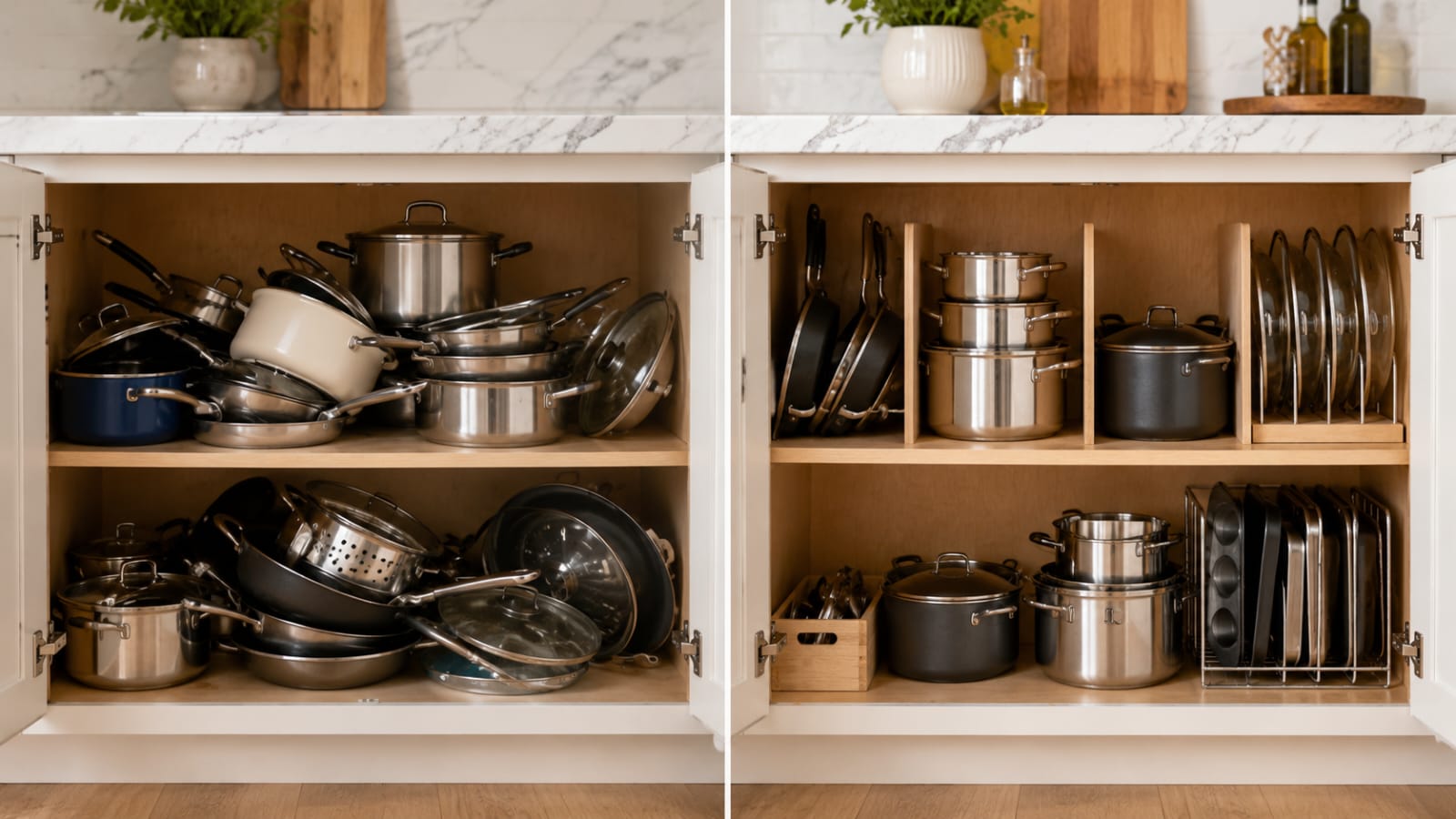
23 Pot and Pan Storage Ideas
1. Use a Pot Rack Above the Stove
A hanging pot rack mounted above your stove keeps your most-used cookware within reach while freeing up an entire cabinet. It’s one of the most popular pot and pan hanging rack ideas. It works in almost any kitchen with enough ceiling clearance.
Choose a hanging pot rack with enough hooks for your daily rotation, and hang your most-used pieces toward the front. A well-organized pot rack also doubles as kitchen decor, especially with copper or stainless cookware that catches the light.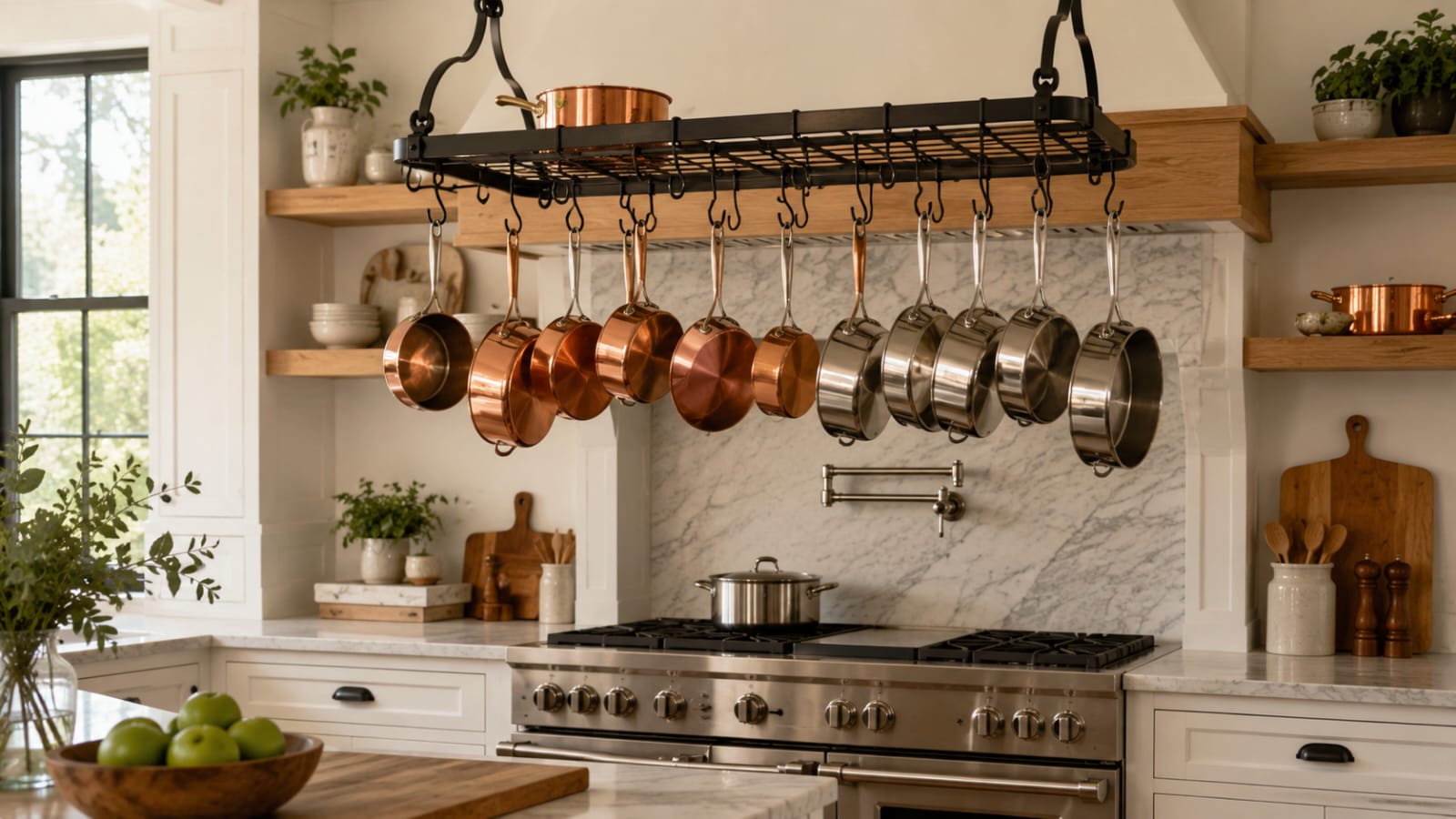
2. Install a Pull-Out Cabinet Organizer
Pull-out organizers slide out from a base cabinet. You can see and reach every pot without digging through a stack. They’re especially useful for deep cabinets where items in back get forgotten.
This works well if you’re not ready to install anything on your walls or ceiling. Most pull-out systems fit your existing cabinet frame with basic hardware. You’ll feel the difference the first time you don’t unstack four pans just to reach the bottom one. Many are DIY-friendly enough to install in an afternoon.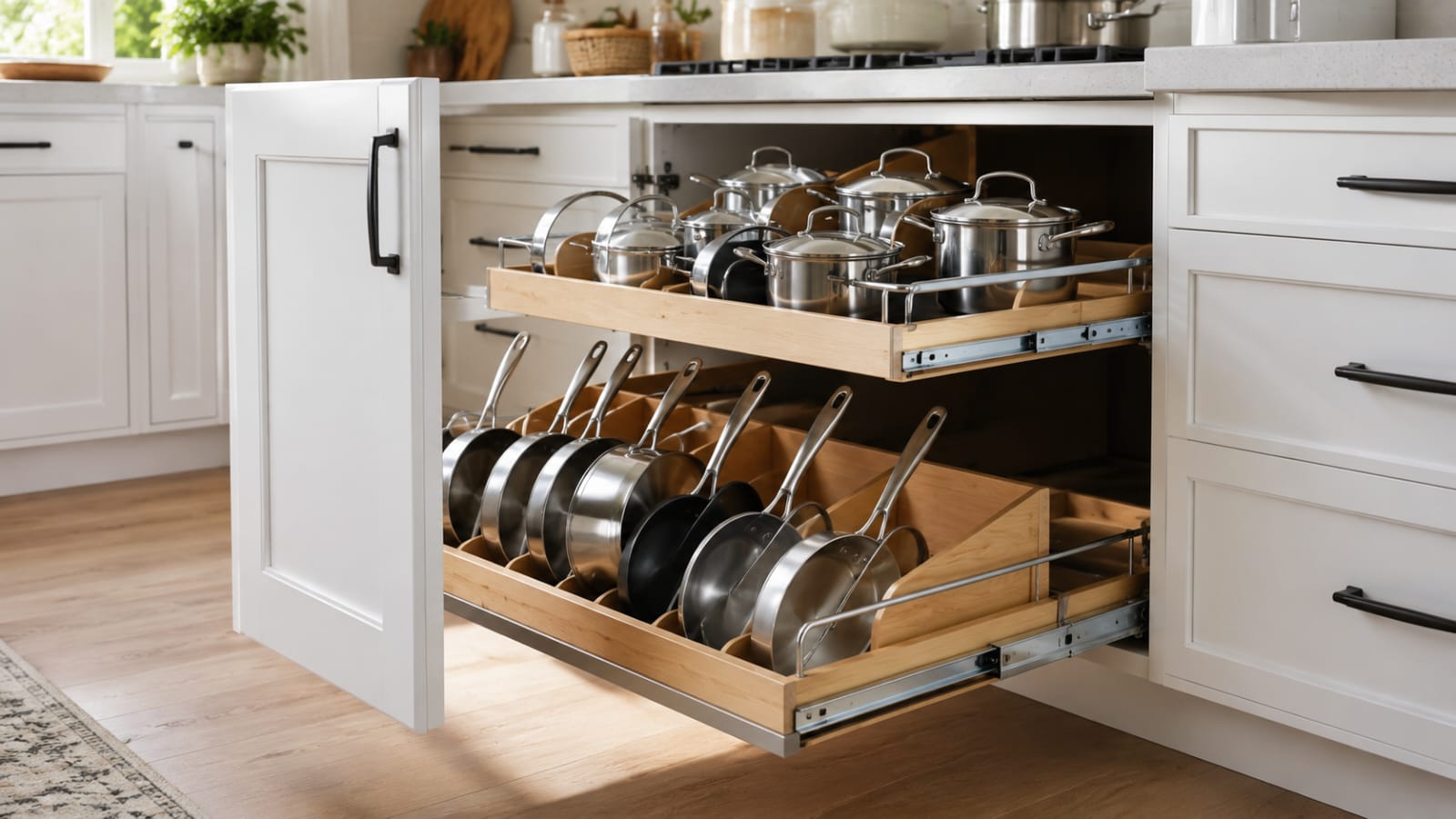
3. Use Vertical Dividers for Pans
Vertical dividers turn a flat cabinet shelf into slots. Baking sheets, cutting boards, and flat pans stand upright instead of stacking. It’s one of the simplest pan storage ideas, with no real installation needed.
Storing pans vertically also protects nonstick coatings, since pieces aren’t rubbing together every time you pull one out. If you bake often, it’s much easier to grab one sheet pan without unstacking the rest.
4. Add a Ceiling-Mounted Hanging Rack
For kitchens with an island or open cooking area, a ceiling-mounted rack keeps cookware visible. It doesn’t take up any counter or cabinet space either. It’s a bigger commitment than a wall rack, but it makes a real style statement.
Keep the rack loaded with pieces you use weekly, not your entire collection. An overloaded ceiling rack looks cluttered fast. A few well-chosen pots can become the visual centerpiece of the kitchen.
5. Use Cabinet Door Organizers for Lids
Lids are often the real culprit behind a messy pot cabinet. A simple wire rack mounted inside a cabinet door holds lids upright and out of the way.
It’s one of the easiest wins on this list, since it uses space that’s usually sitting empty. Once lids have their own spot, the rest of your pot and pan organizer ideas actually stay in place.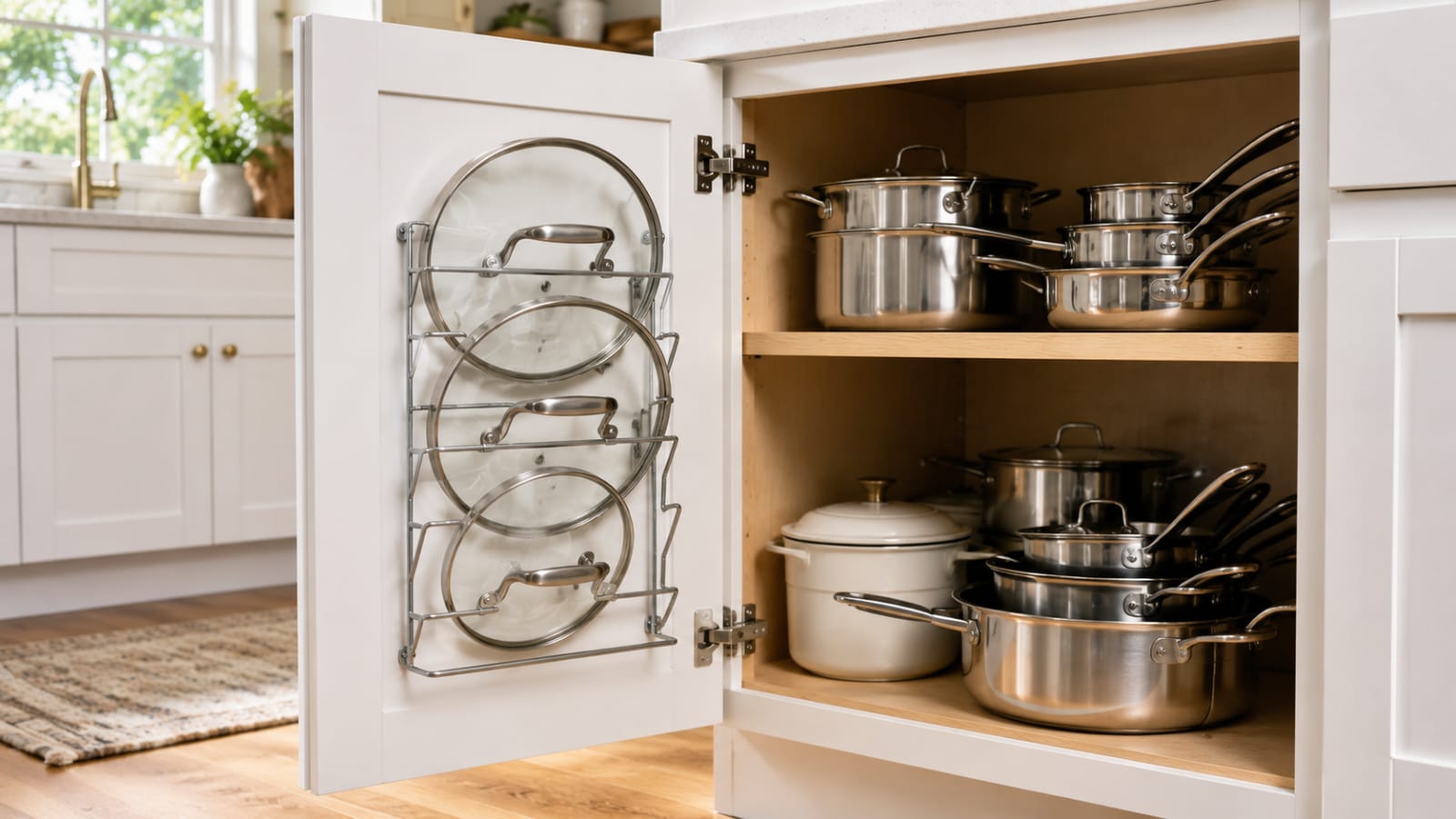
A basic cabinet door lid rack is inexpensive and installs in minutes. It’s usually the first thing worth trying here.
6. Nest Pots Inside Each Other
Nesting is the most basic form of pot and pan storage. Doing it well makes a bigger difference than you’d expect. Stack pots largest to smallest, with a thin felt protector between each one. This prevents scratching and keeps the stack from wobbling.
This works especially well for stainless steel or ceramic-coated cookware, which scratches easily when metal rubs against metal. It won’t solve every problem on its own, but it’s the foundation most other ideas here build on.
7. Use a Pegboard Wall for Pots and Pans
A pegboard mounted on an open wall gives you total flexibility to hang pots, pans, and utensils exactly where you want them. You can rearrange the hooks any time your cookware collection changes or grows.
This works particularly well in smaller kitchens where a dedicated pot rack isn’t practical. A pegboard can be sized to fit almost any open wall. It also keeps everything visible, so nothing gets lost in a cabinet again.
8. Add a Deep Drawer for Heavy Cookware
Deep drawers near the stove are one of the most ergonomic pots and pans storage ideas for small kitchen layouts. You don’t have to bend and dig through a low cabinet anymore. Heavy cookware like Dutch ovens is much easier to lift straight up from a drawer.
If you’re renovating or replacing cabinetry, prioritize at least one deep drawer near your cooking area. It’s a small choice that pays off every day you cook.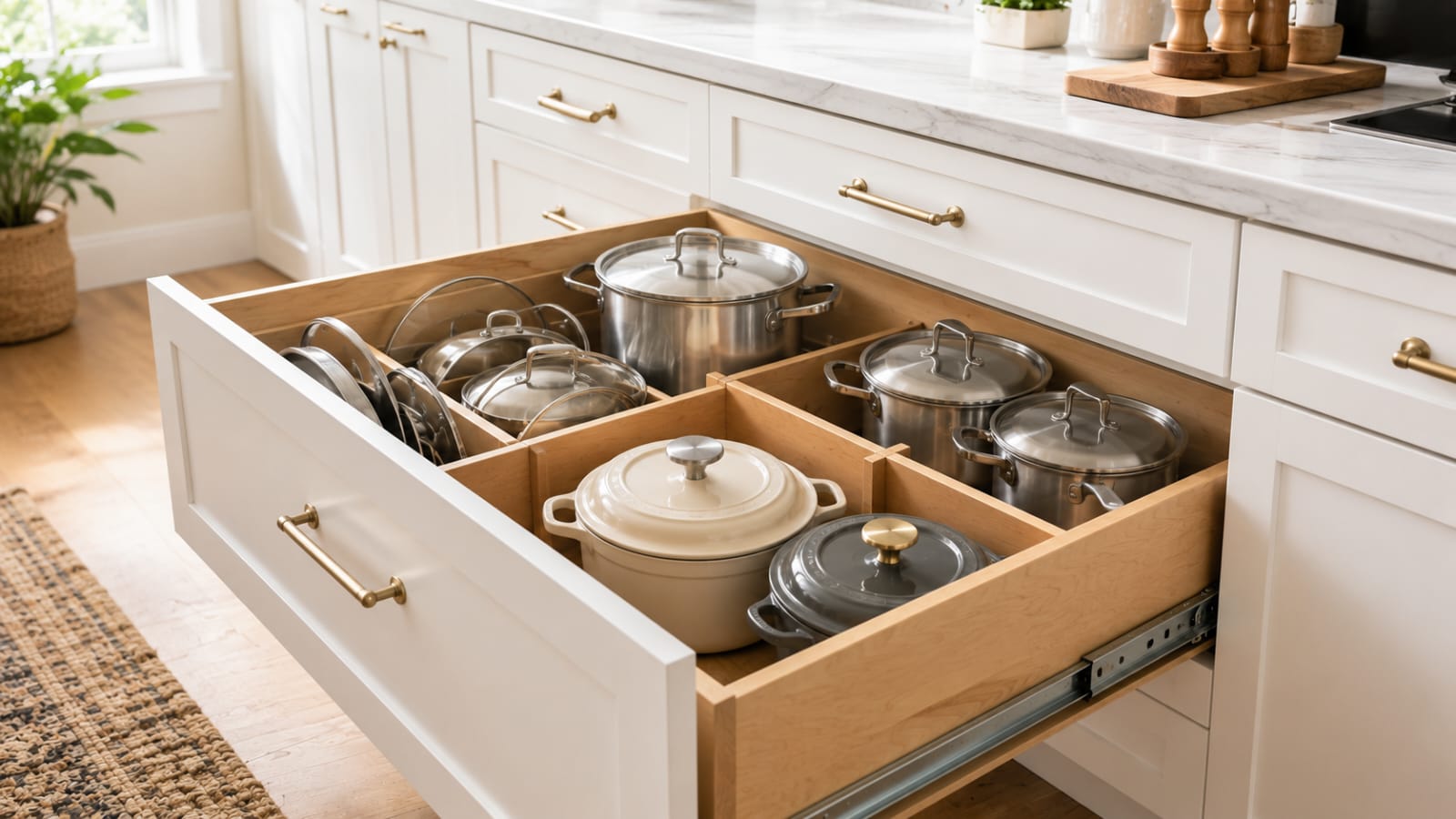
9. Use a Lazy Susan in a Corner Cabinet
Corner cabinets are notorious for wasted space. A lazy Susan turns that dead zone into usable storage for smaller pots and pans. Spinning to find what you need beats reaching blindly into a dark corner.
This is especially useful if your kitchen has one of those awkward blind corner cabinets people usually give up on. A round or kidney-shaped lazy Susan insert can make that section functional again.
10. Hang Pans on a Wall-Mounted Rail
A rail with S-hooks mounted along an open wall gives you a lower-commitment version of a full pot rack. It works well above a stove backsplash or an empty wall section.
It’s one of the more budget-friendly pot and pan hanging rack ideas. A basic rail and a few hooks cost far less than a ceiling-mounted system. It also puts your cookware on display as part of the kitchen’s design.
11. Use a Freestanding Pot Rack
If you’re renting or don’t want to drill into walls or ceilings, a freestanding pot rack solves that. You get the same hanging storage without any installation. These come in sizes from small countertop versions to tall standing units.
A freestanding rack is also fully portable. If you rearrange your kitchen or move, the whole setup goes with you. It won’t leave a single hole in the wall.
12. Store Pans Vertically in a Cabinet
Beyond using dividers, you can simply store pans on their sides rather than stacked flat. This works well for cast iron skillets and frying pans that don’t nest neatly with other pieces. It’s especially useful for ones with tall handles.
Vertical storage also makes it easier to see what you own. A stack of flat pans hides everything except the top piece. A vertical row lets you scan the whole collection at a glance instead.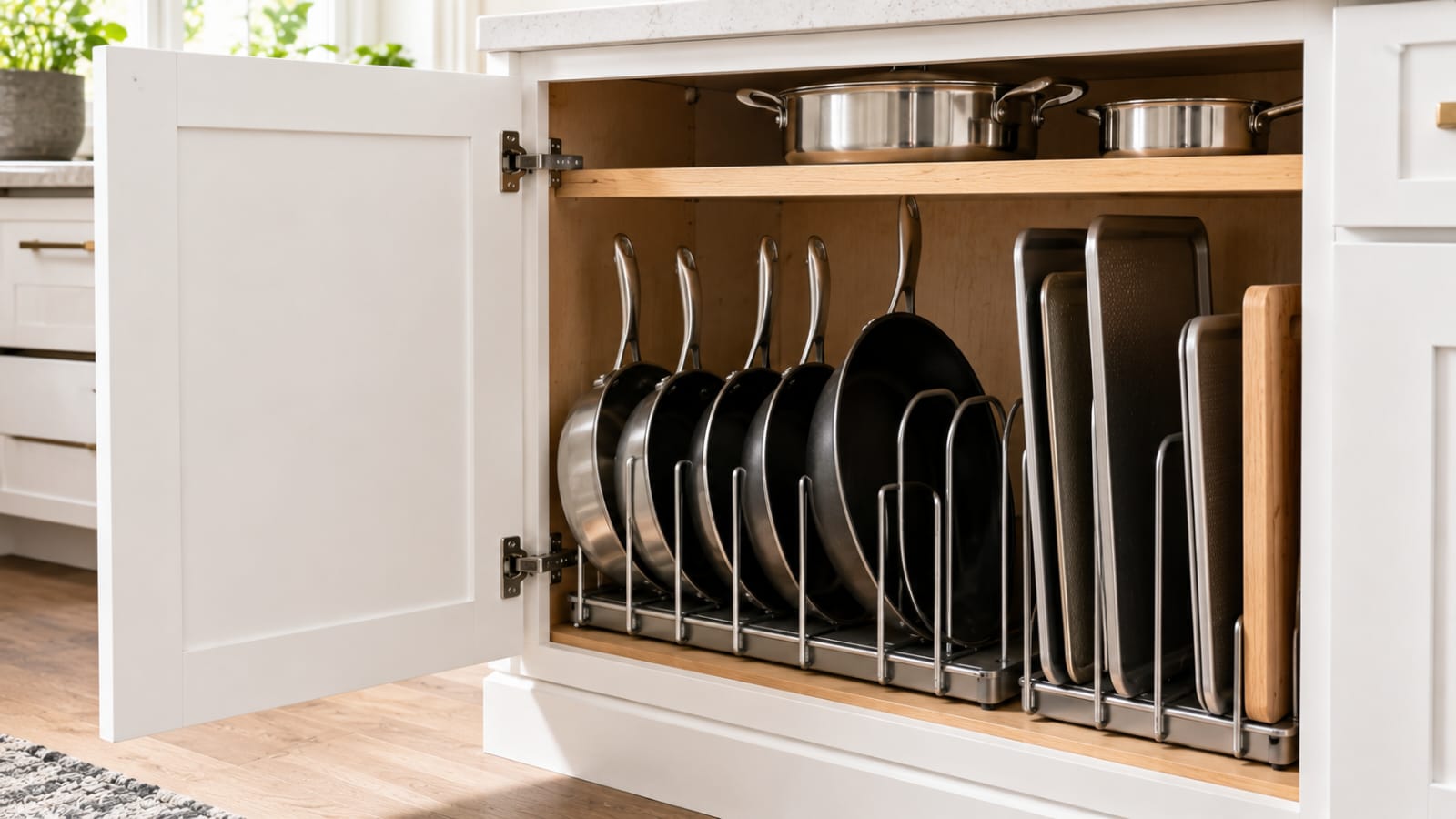
13. Use a Pull-Out Pan Drawer
Similar to a pull-out organizer, a dedicated pan drawer built for flat cookware slides out. You get full access without any stacking. Many come with adjustable dividers you can resize as your collection changes.
This is a good mid-range option if a full drawer replacement feels like too much, but a simple divider isn’t enough on its own. It bridges the gap between a basic organizer and a full renovation.
14. Add Hooks Inside Cabinet Doors
Small adhesive or screw-in hooks inside a cabinet door can hold pot holders, small lids, or a stray measuring cup. Otherwise those items just clutter a shelf. It’s a tiny addition that adds up when you’re maximizing every inch of storage.
This idea pairs especially well with our kitchen cabinet organization ideas. Small hook additions like this work throughout the kitchen, not just in the pot and pan cabinet.
15. Use a Rolling Cart for Extra Cookware
If your everyday cabinets are full, a rolling cart tucked into a pantry or corner solves the overflow problem. It can hold cookware you use less often, like a turkey roaster or extra stockpot. Roll it out when you need it, then tuck it away.
This is a good option for anyone dealing with small kitchen storage. A cart can live outside the kitchen entirely, in a nearby closet or pantry, without losing easy access.
16. Store Lids in a Dedicated Lid Organizer
Beyond cabinet door racks, a standalone lid organizer works too. It sits on a shelf or in a drawer and keeps lids sorted by size without needing wall or door space. Some use adjustable pegs, others are simple slotted trays.
Once lids have a real home, you’ll stop losing time matching the right one to the pot you’re using. It’s a small system that removes a common kitchen frustration.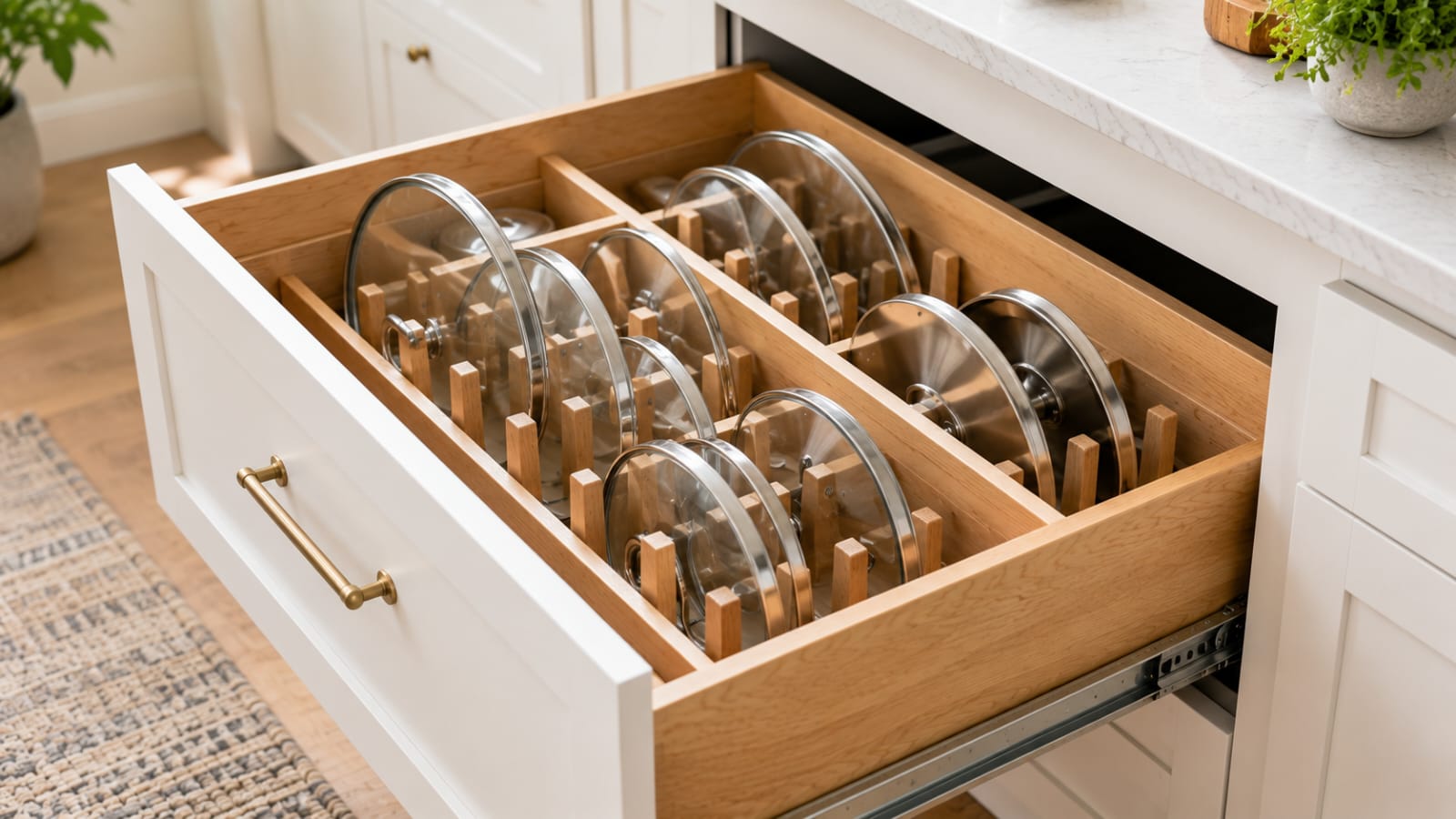
If you’re shopping for one, look for an adjustable lid organizer Pegs you can reposition make it easy to adapt as your cookware collection changes.
17. Use Open Shelving for Everyday Pots
Open shelves near the stove keep your most-used pots visible and within reach. It’s similar to a pot rack, just without the hanging hardware. This works well if you already have shelving and just need a better system.
Group pots by size, largest on the bottom, and keep the shelf edited to pieces you actually reach for weekly. An overstuffed shelf looks more like clutter than storage, so rotate seasonal pieces out to a cabinet instead.
18. Hang Pots from an S-Hook Rail
A simple curtain rod or metal rail with S-hooks can turn almost any wall or window into extra pot storage. It’s one of the lowest-cost pot and pan hanging rack ideas here, since the materials are cheap and widely available.
This works especially well above a kitchen window near your cooking area. It uses vertical space that would otherwise go unused.
19. Choose Stackable Cookware Sets
If you’re shopping for new cookware, look for sets designed to nest and stack efficiently. Some brands build their pots and pans with flat, interlocking bases and matching lid sizes. These take up far less cabinet space than mismatched pieces collected over the years.
This won’t help with cookware you already own, but it’s worth remembering next time you replace a worn-out set. A little research before buying saves frustration later.
20. Use a Baker’s Rack for Overflow Storage
A baker’s rack positioned near the kitchen, even in a dining area or hallway, can hold cookware that doesn’t fit in your main storage space. This works especially well in older homes with smaller kitchen layouts.
It’s also a nice way to display cast iron or copper cookware that looks good out in the open. A storage problem becomes a decor feature instead.
21. Keep Cast Iron on a Low, Sturdy Shelf
Cast iron pans are heavy. Storing them on a high shelf means lifting significant weight above your head every time you need one. Keep cast iron on a low, sturdy shelf or bottom cabinet where it’s easier and safer to reach. This matters most if you’re cooking solo, with no spotter for a ten-pound skillet.
This also protects your other cookware, since cast iron can scratch or dent lighter pieces stacked beneath it. A separate, dedicated spot solves two problems with one small change.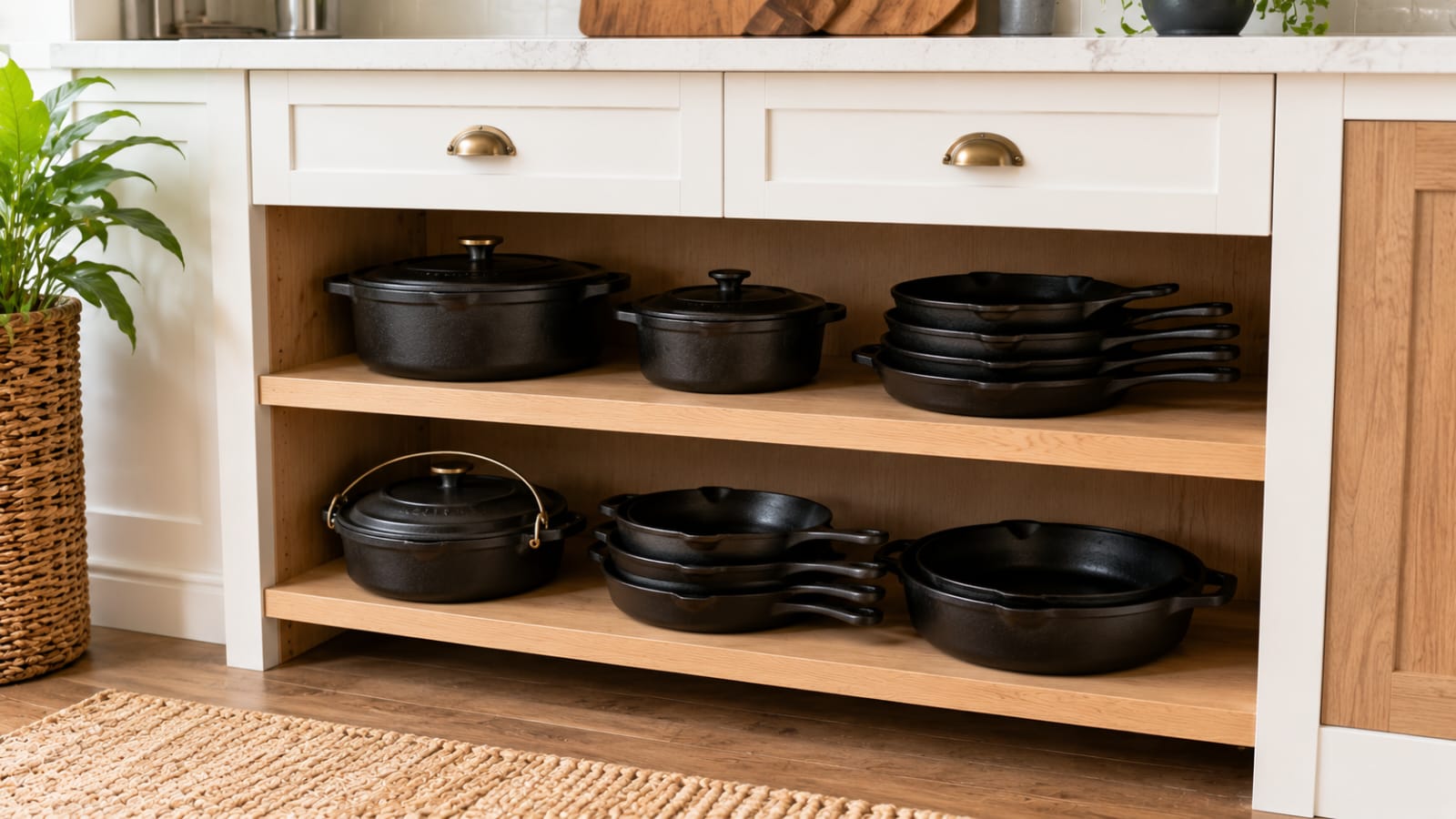
22. Line Drawers to Protect Pots and Pans
A simple rubber or felt drawer liner protects your cookware and cabinetry from scratches caused by pots sliding around. It’s an easy, inexpensive addition to any drawer-based system here.
This small step also cuts down on noise. Pots sliding across a bare wood or laminate drawer can be surprisingly loud. A roll of non-slip drawer liner covers several drawers and costs less than you’d expect.
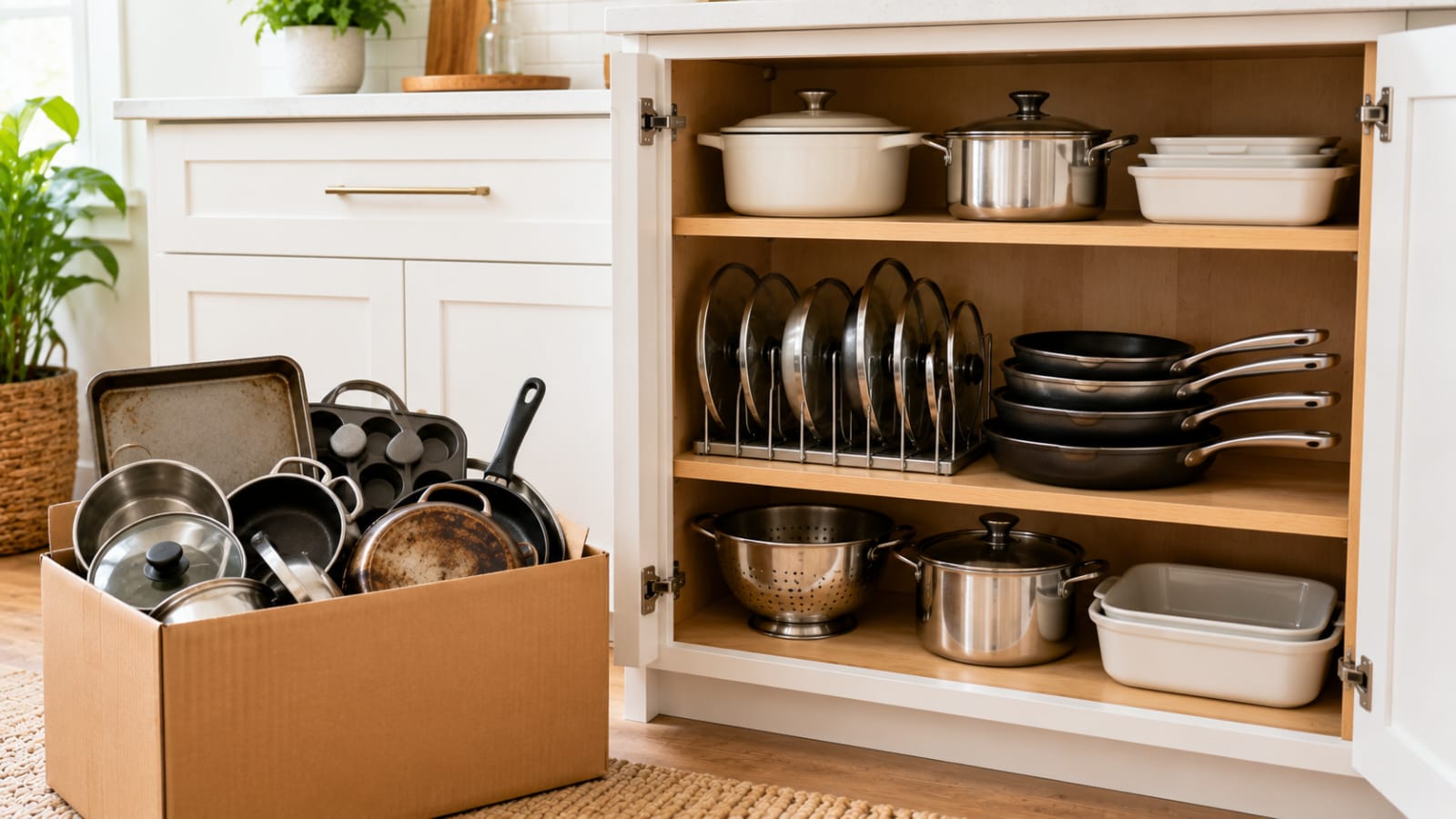
23. Donate Cookware You No Longer Use
Before buying any new storage solution, sort through your cookware first. Set aside anything you haven’t used in the past year. Duplicate pans, warped baking sheets, and orphan lids rarely earn their space back.
Fewer, better-used pieces make any pot and pan storage idea on this list work better. You’re organizing what you actually need, not everything you’ve ever owned. Our pantry organization ideas and under kitchen sink storage ideas follow this same declutter-first approach.
Conclusion
Good pot and pan storage ideas come down to matching the system to how you actually cook. It’s not about cramming everything into whatever cabinet is closest to the stove. Whether that means a hanging rack, a pull-out drawer, or just nesting your pots more thoughtfully, small changes add up fast anyway.
Pick one idea that fits your kitchen and budget, and start there. Once you’ve solved the pot and pan puzzle, the rest of your kitchen organization tends to fall into place more easily. That includes everything from small kitchen storage ideas to cabinet layouts.
Start with one storage solution that fits your kitchen and cooking style. Even a small upgrade can free up cabinet space and make meal prep much easier.

Hi, I’m Shankar, the founder of Nestory Home. I share practical home organization, storage, and home decor ideas to help you create a clean, functional, and beautiful home. Every guide is designed to be simple, budget-friendly, and easy to put into practice.